Why North Georgia's Red Clay Is Hard on Your Foundation (and What to Watch For)
Georgia's red clay holds water against basements and crawlspaces after every rain. Here's why — and the warning signs to watch for before repairs get expensive.
If you live anywhere from Buford to Gainesville, Cumming to Dahlonega, you already know Georgia red clay. It stains your shoes, your truck, and your driveway. What most homeowners don't realize is that the same clay is working against their foundation every time it rains.
At Precision Waterproofing & Foundation Repair, a large share of the basement leaks, wall cracks, and damp crawlspaces we see across North Georgia trace back to one thing: how our soil handles water.
What Makes Red Clay Different
Red clay gets its color from iron in the soil. Its real problem is texture. Clay particles are extremely fine and packed tightly together, so water soaks in slowly and drains out even more slowly.
That leads to three problems for your home:
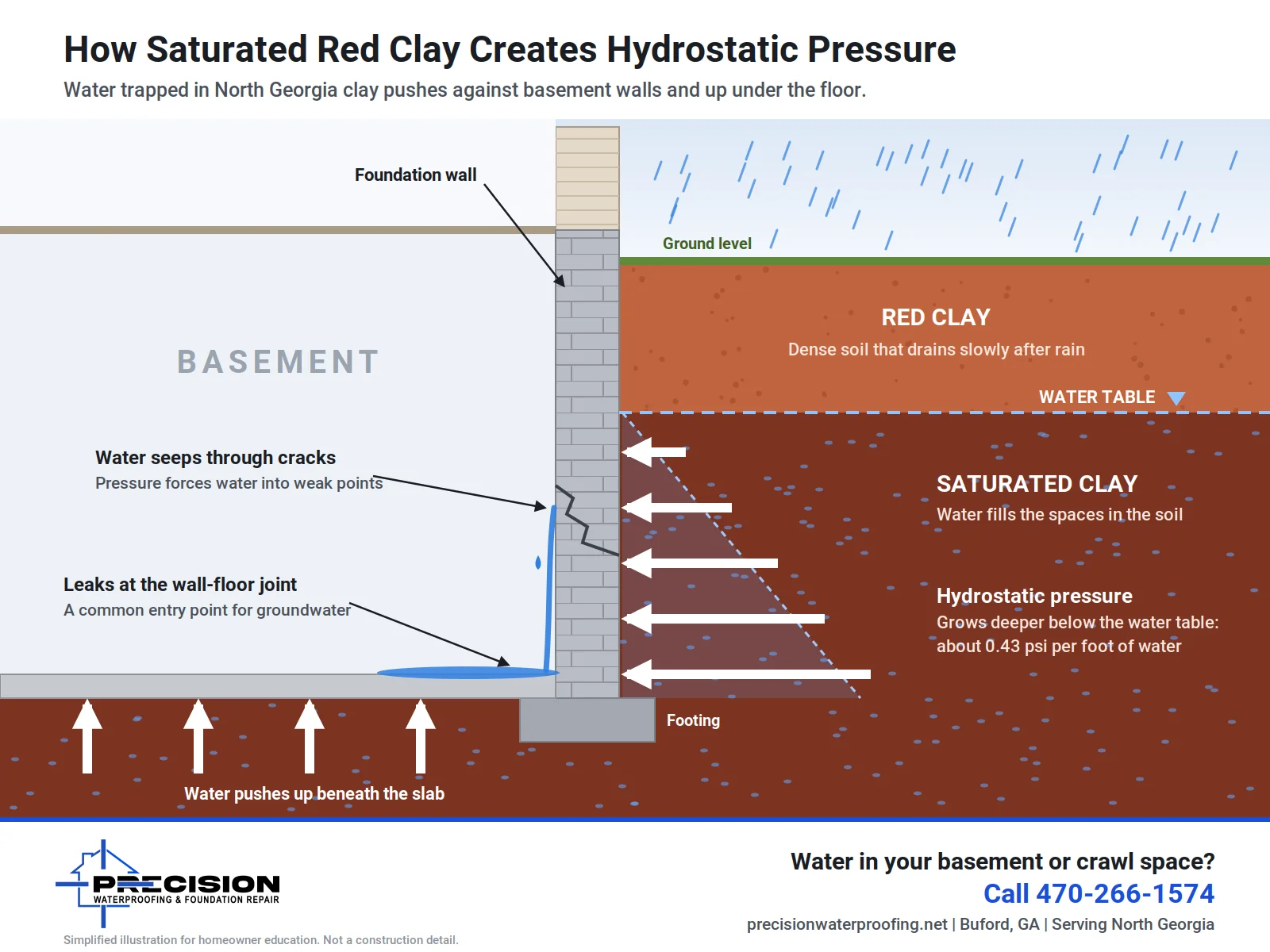
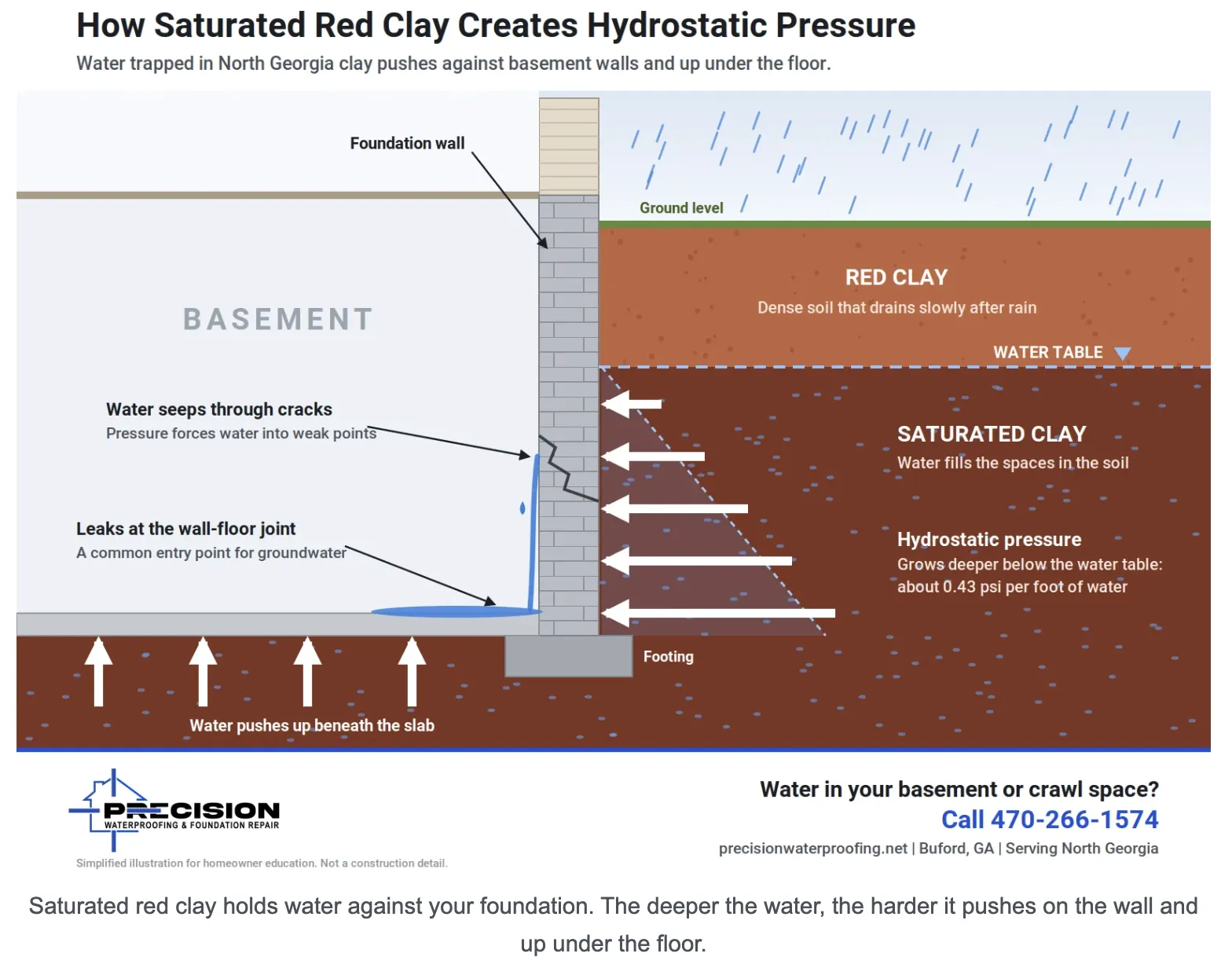
Saturated red clay holds water against your foundation. The deeper the water, the harder it pushes on the wall and up under the floor.
It holds water against your walls. After a heavy rain, the clay around your foundation can stay saturated for days. That trapped water pushes against basement and crawlspace walls, a force called hydrostatic pressure.
It moves with moisture. Clay softens when wet and firms up and shrinks as it dries. Repeated wet and dry cycles can shift the soil supporting your footings.
It drains poorly on its own. Water that can't soak into the ground runs along the surface or collects beside the house, often right where your foundation meets the soil.
The Hillside Factor
Much of North Georgia is built on rolling, sloped lots. Many homes sit on ground that was cut and filled during construction. The fill soil placed around a new foundation (called backfill) is often looser than the undisturbed ground around it, so it settles over the years and can direct water straight toward the house.
If your home is on a slope, has a walkout basement, or sits below the street, water management matters even more.
Crawlspaces Feel It Too
Homes built over a crawlspace aren't off the hook. In many North Georgia crawlspaces, the floor is simply exposed red clay. When the ground outside stays saturated, water can seep in and collect in low spots, especially around block piers and footings.
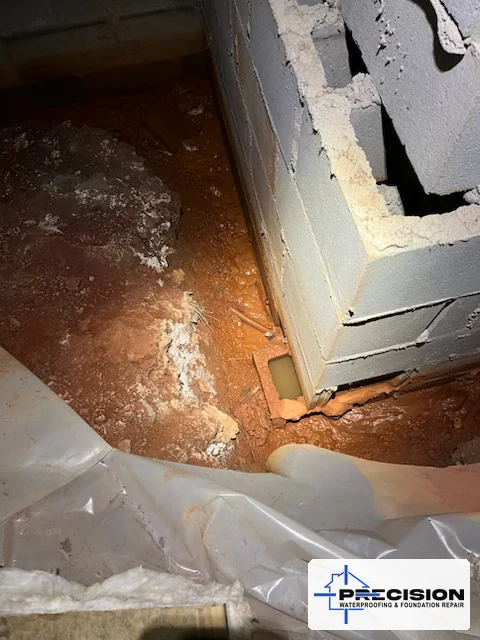
A North Georgia crawlspace photographed by Precision. Water has pooled in the red clay at the base of the block foundation, and the plastic vapor barrier no longer covers the soil.
Standing water and damp clay under your home raise humidity in the crawlspace, which can lead to musty odors, wood rot, and moisture problems in the floors above. A loose or torn vapor barrier lets that moisture right back into the space. Proper crawl space repair and a crawl space drain system address the water first, then seal the space so it stays dry.
Warning Signs to Look For
Walk around your home and check for the signs below. (For a deeper look, see our guide to the top 7 warning signs of foundation problems.)
Cracks in basement or crawlspace walls, especially horizontal cracks, stair-step cracks in block walls, or cracks that are getting wider
Water or damp spots at the base of basement walls or where the wall meets the floor
White, chalky residue (efflorescence) on block or concrete, a sign water has been moving through the wall
Bowing or leaning walls, which can often be stabilized with carbon fiber straps or steel I-beams
Doors and windows that stick or no longer latch
Musty smells, standing water, or high humidity in the crawlspace
Soil sloping toward the house or gutters dumping water right next to the foundation
Finished Basements Can Hide the Problem
In a finished basement, drywall and paneling can cover a leak for months. Watch for stained or swollen baseboards, peeling paint, damp carpet, or a musty smell along an outside wall.
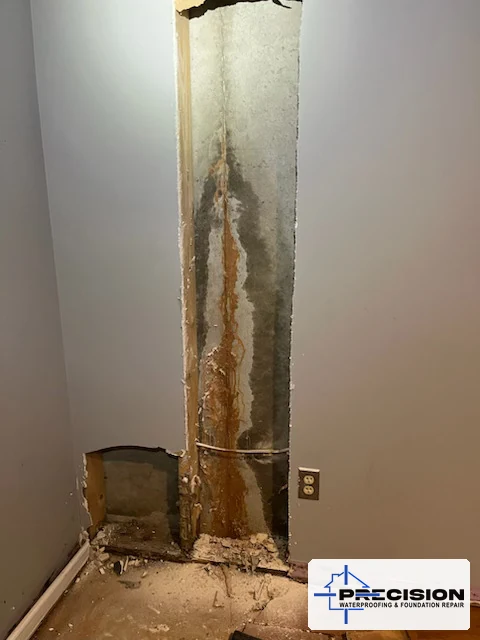
What Precision found behind the drywall in a North Georgia basement. Water carrying red clay came through a crack in the foundation wall and stained the concrete all the way to the floor.
That orange streak is the clay itself. When saturated soil pushes water through a crack, it carries fine clay particles with it, a clear sign the water is coming from outside the wall. See how we handle foundation crack repair and crack injections.
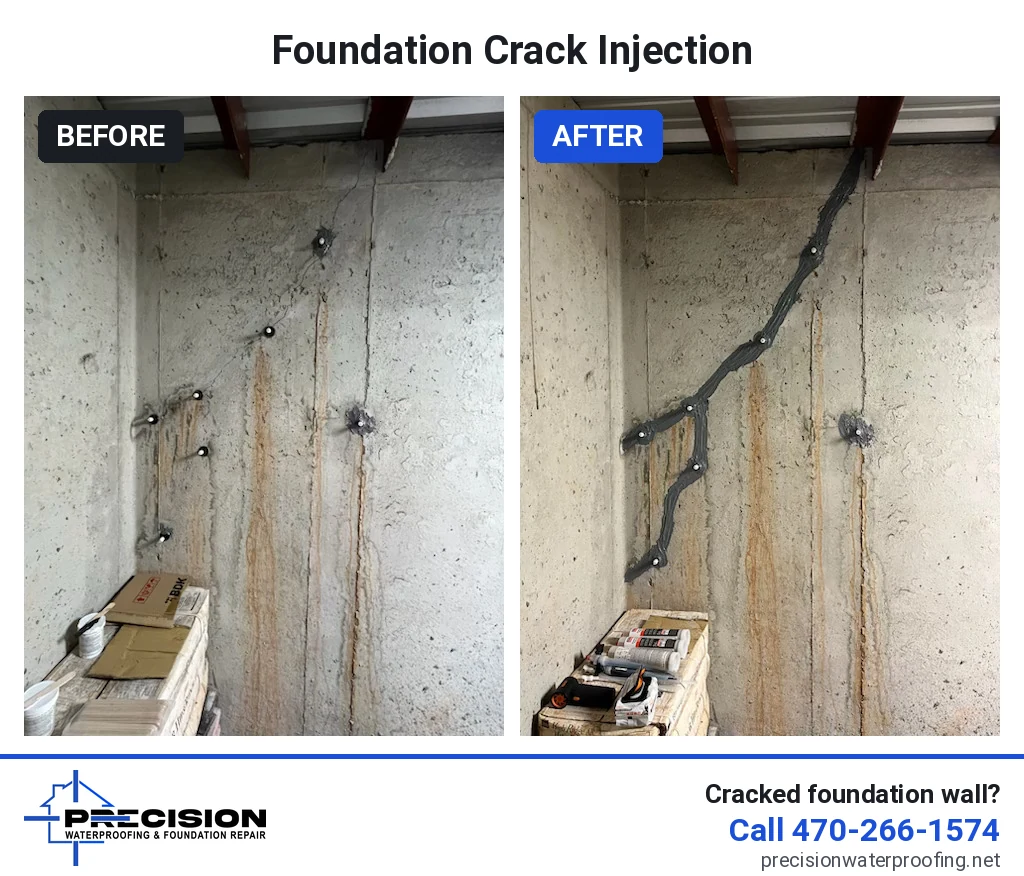
A Precision crack injection job. Before: injection ports set along a cracked foundation wall. After: the crack sealed along its full length to stop water from coming through.
One sign on its own isn't always cause for alarm. Several together, or anything that keeps getting worse, deserves a professional look.
Simple Steps You Can Take Now
Some of the best protection costs very little:
Clean your gutters and make sure downspouts discharge well away from the house, ideally several feet or more
Regrade low spots so soil slopes away from the foundation
Keep mulch beds and landscaping from trapping water against the walls
Watch for pooling water after storms and note where it collects
These steps reduce the amount of water the clay has to hold against your home.
When It's Time to Call a Professional
DIY fixes help with surface water, but they can't relieve pressure that's already built up in the soil or stabilize a foundation that has started to move. Depending on what we find, solutions may include:
Interior or exterior waterproofing and drainage systems that collect groundwater and carry it away
Sump pump systems to discharge collected water (here's what to know about sump pump electrical requirements)
Crawlspace encapsulation and repair to control moisture and humidity, often paired with a crawl space drain system
Foundation piers to stabilize settling footings as part of our foundation repair services
Wall repair and reinforcement for cracked or bowing walls, including crack injections, carbon fiber strapping, and I-beam wall support
Excavation and regrading to correct drainage problems at the source
Every home and lot is different, which is why we start with an on-site evaluation instead of a one-size-fits-all fix.
Local Experience Matters
Our crews work in North Georgia soil every day. We know how it behaves after a week of winter rain and after a dry summer, and we build our repairs around those conditions. You can see recent North Georgia jobs on our projects page.
Seeing cracks, water, or a damp crawlspace? Call Precision Waterproofing & Foundation Repair at 470-266-1574 or request an estimate online to schedule an evaluation. We're based in Buford and serve homeowners across North Georgia.